Simplified Strategies & Support For
female entrepreneurs
~ Create, Grow & Thrive with Confidence ~
Hey there! You might find some affiliate links in this blog. If you decide to make a purchase through one, I may earn a small commission. It helps keep this space running, and I only share things I personally find valuable. Thanks for being here!
Blog Posts
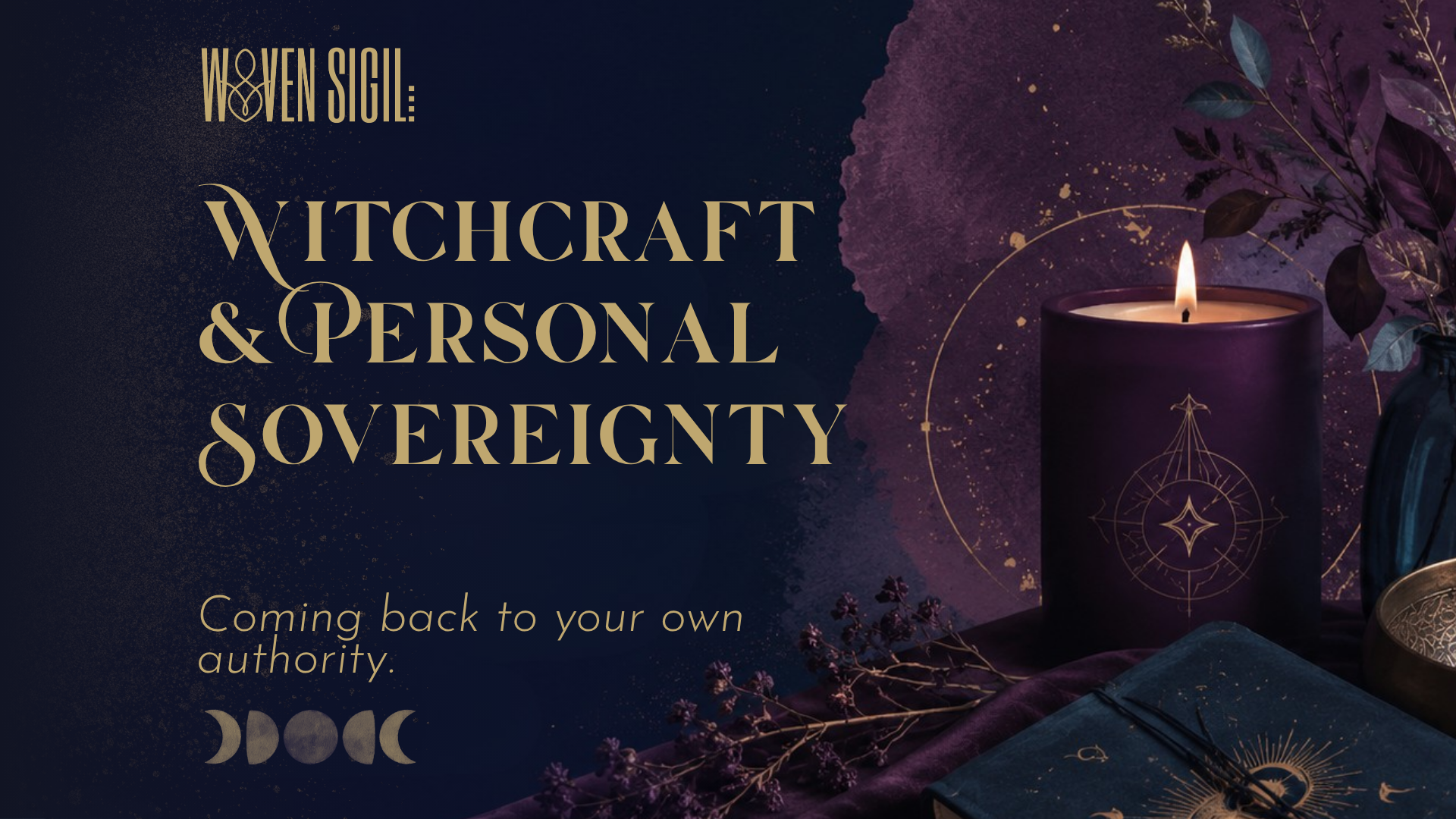
Witchcraft and Personal Sovereignty: Coming Back to Your Own Authority
The word “sovereignty” gets used a lot in spiritual spaces. Usually in a very vague way. Often as a synonym for self-care, or as a shorthand for “you're allowed to do things your way” — which, yes, fine, but that's a low bar for a concept that I actually believe has real weight to it.
Sovereignty, properly considered, means something more specific: the authority to govern oneself. To determine what you actually believe, what you have reason to trust, and how you will act on it. To act from your own values and perception rather than from inherited rules, social pressure, or the accumulated weight of other people's opinions about what your practice should look like.
That includes moral authority, which I think gets overlooked in conversations about spiritual sovereignty. In Christianity, morality ultimately has an external reference point: God says this is right, scripture says this is wrong, and your responsibility is to live accordingly. A sovereign spiritual practice asks something harder of you. You still have to decide what is right and wrong, but you don't get to end the inquiry with because God said so. You have to think about why something is right, what harm your choices might cause, what responsibilities you have to other people, and what kind of person you are choosing to be. You aren't behaving ethically because a divine authority requires it or because you're afraid of spiritual punishment. You're choosing to behave ethically because you have decided that it matters.
That, to me, is a much more substantial form of sovereignty than simply being allowed to make your own rules.
In witchcraft, this is both the premise and the ongoing practice. It's the premise because most people are drawn to practice precisely because they want a spiritual life that doesn't require permission from an institution. And it's the ongoing practice because removing institutional authority doesn't automatically replace it with self-authority. That part takes longer. Nobody hands it to you when you leave the old structure. You have to build it.
Why This Matters More Than It Sounds
There's a specific dynamic that shows up repeatedly among people who've been practicing for a while. They've left one set of rules — the religion they were raised in, the tradition that no longer fits, the teacher whose framework started feeling like a cage — and they've entered a space that doesn't have those rules. But the instinct to seek external validation doesn't leave just because the external authority has changed.
So instead of “Am I doing this right according to my religion,” the question becomes “Am I doing this right according to the tradition? According to what I've read? According to what the most experienced practitioners in this space say?” The hunger for an external arbiter persists. The authority just…moves.
We learn to locate authority outside ourselves from a young age, and unlearning that instinct is actual work, not just a decision. Recognizing that you've swapped one external authority for another is the first useful step.
The move toward witchcraft and non-institutional practice isn't just aesthetic or cultural. For many people it's specifically about recovering a relationship with their own perception. The point is not to exchange one set of prescriptions for another but to develop the capacity to assess your own experience and trust what you find there.
What Reclaiming Your Authority Actually Involves
Personal sovereignty in practice is less dramatic than it sounds. It's mostly a set of habits of perception.
Noticing what you actually believe versus what you've been told to believe. This isn't about rejecting received wisdom — there's genuine accumulated knowledge in tradition and experienced practitioners. It's about being able to distinguish between something you've genuinely tested and found true, and something you're doing/believing because someone else said it was true and you haven't gotten around to examining it.
A useful question: Where does my sense of what's “correct” in my practice come from? If the honest answer is “from a book I read five years ago” or “from someone whose authority I've never actually questioned,” that's worth reconsidering. Not necessarily changing, but considering.
Following your actual experience over the prescribed experience. Prescribed experiences are the ones you're supposed to have: the new moon is supposed to feel like beginnings, the full moon is supposed to feel like abundance, shadow work is supposed to be difficult and then releasing. Sometimes it does. Sometimes it doesn't. Your actual experience is more useful than the prescribed one.
If a specific correspondence doesn't resonate for you, you don't have to use it. If a particular moon phase consistently feels flat rather than energizing, you can work with a different one. Direct experience deserves a place in the evaluation, but it isn't automatically infallible either. We misinterpret things. We bring biases, expectations, fears, and wishful thinking into spiritual practice just as we do everywhere else. Sovereignty doesn't mean assuming your first interpretation is correct. It means the final work of evaluating it belongs to you.
Resisting the urge to outsource discernment. The instinct to find someone else who can tell you what something means — a card pull, a dream, an experience during ritual — is understandable. Interpretation is hard. But the consistent outsourcing of finding meaning to external sources is also a way of not trusting your own capacity to know things. You're building a skill when you sit with something and arrive at your own interpretation.
The Difference Between Sovereignty and Isolation
Personal sovereignty in spiritual practice is not the same as refusing to learn from others, rejecting community, or treating every received idea as automatically suspect.
Tradition exists because accumulated experience is genuinely useful. The correspondences between herbs and intentions, the ritual structures that have held for centuries, the cosmologies that have organized human experience across cultures — these have survived because they contain real knowledge. Sovereignty isn't about dismissing that knowledge. It's about relating to it as a practitioner with her own discernment, rather than as a student who simply receives and applies.
The distinction matters because the unhelpful version of “my practice belongs to me” sometimes becomes a closed loop — only trusting what you already think, never being genuinely moved by an idea that contradicts your current view, treating learning as a form of compromise rather than expansion. That's not sovereignty it’s just…rigid.
The productive version looks more like this: you engage seriously with received knowledge, you test it against your own experience, and you arrive at your own relationship to it. Some of it you find true and useful. Some of it doesn't quite fit your actual practice. Some of it you hold loosely and revisit. The authority to decide which is which belongs to you.
This is also why community remains useful even for practitioners committed to developing their own inner authority. Being genuinely challenged by someone else's perspective — not capitulating to it, but actually engaging with it — is part of how discernment gets stronger. Isolation disguised as sovereignty tends to narrow rather than deepen.
But Authority Comes With Responsibility
Self-authority doesn't mean every conclusion you reach is automatically correct. It means the responsibility for examining your conclusions belongs to you.
If you decide that a traditional rule doesn't apply to your practice, that's your decision to make. But sovereignty doesn't exempt that decision from scrutiny. Why are you rejecting it? What was the rule originally trying to accomplish? Who could be affected by your choice? Are you acting from considered values, convenience, defensiveness, fear, or simply because you don't like being told no?
Having the authority to make a decision also means accepting responsibility for what follows from it.
Spiritual Bypassing vs. Inner Authority
One place where sovereignty and bypassing can get confused is in the use of spiritual practice to avoid uncomfortable information.
Bypassing is using spiritual frameworks to skip rather than process what's difficult: explaining conflict away with “energy,” avoiding accountability by reframing it as “their energy, not mine,” using concepts like “high vibration” to avoid sitting with grief, anger, or doubt.
Sovereignty is almost the opposite: it requires being willing to encounter what's actually true, including what's uncomfortable. The self-knowing that genuine sovereignty rests on doesn't avoid difficult information. It includes it.
The difference matters because both can sound like personal authority. Both can use the language of “my own truth” or “what's right for me.” But one is an expansion of self-knowledge and the other is a contraction of it.
A useful check: Does my current practice expand my capacity to know myself honestly, or does it provide reasons not to look at things too closely?
What This Looks Like in Practice
This doesn't require any particular changes to what you do. Sovereignty is less about the content of your practice and more about your relationship to it.
Some questions that can be genuinely clarifying, practiced over time:
Why do I do this? Not “because it's what you do at the new moon” or “because I've always done it.” What is the actual intention behind this element of my practice? What does it do for me?
What do I actually believe? Not what I'm supposed to believe, not what the tradition says, but what I've genuinely found to be true in my own experience?
Where am I still waiting for permission? There's usually somewhere. The habit of seeking external validation is persistent. Noticing where it's still operating in your practice is useful.
What would I do differently if no one was watching? Not as a license to abandon all perception, but as a genuine diagnostic. The gap between your observed practice and your solo practice is information about where external authority still has a hold of you.
Related: Wicca vs. Witchcraft: A Beginner's Guide to Your Path
Personal sovereignty isn't a destination. It's just a direction. The practice of returning to your own authority, noticing when you've handed it off, and retrieving it again. But authority and responsibility come together. If you claim the right to decide what you believe, how you practice, and what values you live by, you also take responsibility for examining those choices honestly and changing them when they no longer hold up to scrutiny.
That's what makes sovereignty an ongoing practice rather than a declaration. You don't announce yourself sovereign and become immune to influence, error, or doubt. You keep learning. You keep questioning. You keep deciding. And, when necessary, you decide differently.

Witchcraft and Personal Sovereignty: Coming Back to Your Own Authority
The word “sovereignty” gets used a lot in spiritual spaces. Usually in a very vague way. Often as a synonym for self-care, or as a shorthand for “you're allowed to do things your way” — which, yes, fine, but that's a low bar for a concept that I actually believe has real weight to it.
Sovereignty, properly considered, means something more specific: the authority to govern oneself. To determine what you actually believe, what you have reason to trust, and how you will act on it. To act from your own values and perception rather than from inherited rules, social pressure, or the accumulated weight of other people's opinions about what your practice should look like.
That includes moral authority, which I think gets overlooked in conversations about spiritual sovereignty. In Christianity, morality ultimately has an external reference point: God says this is right, scripture says this is wrong, and your responsibility is to live accordingly. A sovereign spiritual practice asks something harder of you. You still have to decide what is right and wrong, but you don't get to end the inquiry with because God said so. You have to think about why something is right, what harm your choices might cause, what responsibilities you have to other people, and what kind of person you are choosing to be. You aren't behaving ethically because a divine authority requires it or because you're afraid of spiritual punishment. You're choosing to behave ethically because you have decided that it matters.
That, to me, is a much more substantial form of sovereignty than simply being allowed to make your own rules.
In witchcraft, this is both the premise and the ongoing practice. It's the premise because most people are drawn to practice precisely because they want a spiritual life that doesn't require permission from an institution. And it's the ongoing practice because removing institutional authority doesn't automatically replace it with self-authority. That part takes longer. Nobody hands it to you when you leave the old structure. You have to build it.
Why This Matters More Than It Sounds
There's a specific dynamic that shows up repeatedly among people who've been practicing for a while. They've left one set of rules — the religion they were raised in, the tradition that no longer fits, the teacher whose framework started feeling like a cage — and they've entered a space that doesn't have those rules. But the instinct to seek external validation doesn't leave just because the external authority has changed.
So instead of “Am I doing this right according to my religion,” the question becomes “Am I doing this right according to the tradition? According to what I've read? According to what the most experienced practitioners in this space say?” The hunger for an external arbiter persists. The authority just…moves.
We learn to locate authority outside ourselves from a young age, and unlearning that instinct is actual work, not just a decision. Recognizing that you've swapped one external authority for another is the first useful step.
The move toward witchcraft and non-institutional practice isn't just aesthetic or cultural. For many people it's specifically about recovering a relationship with their own perception. The point is not to exchange one set of prescriptions for another but to develop the capacity to assess your own experience and trust what you find there.
What Reclaiming Your Authority Actually Involves
Personal sovereignty in practice is less dramatic than it sounds. It's mostly a set of habits of perception.
Noticing what you actually believe versus what you've been told to believe. This isn't about rejecting received wisdom — there's genuine accumulated knowledge in tradition and experienced practitioners. It's about being able to distinguish between something you've genuinely tested and found true, and something you're doing/believing because someone else said it was true and you haven't gotten around to examining it.
A useful question: Where does my sense of what's “correct” in my practice come from? If the honest answer is “from a book I read five years ago” or “from someone whose authority I've never actually questioned,” that's worth reconsidering. Not necessarily changing, but considering.
Following your actual experience over the prescribed experience. Prescribed experiences are the ones you're supposed to have: the new moon is supposed to feel like beginnings, the full moon is supposed to feel like abundance, shadow work is supposed to be difficult and then releasing. Sometimes it does. Sometimes it doesn't. Your actual experience is more useful than the prescribed one.
If a specific correspondence doesn't resonate for you, you don't have to use it. If a particular moon phase consistently feels flat rather than energizing, you can work with a different one. Direct experience deserves a place in the evaluation, but it isn't automatically infallible either. We misinterpret things. We bring biases, expectations, fears, and wishful thinking into spiritual practice just as we do everywhere else. Sovereignty doesn't mean assuming your first interpretation is correct. It means the final work of evaluating it belongs to you.
Resisting the urge to outsource discernment. The instinct to find someone else who can tell you what something means — a card pull, a dream, an experience during ritual — is understandable. Interpretation is hard. But the consistent outsourcing of finding meaning to external sources is also a way of not trusting your own capacity to know things. You're building a skill when you sit with something and arrive at your own interpretation.
The Difference Between Sovereignty and Isolation
Personal sovereignty in spiritual practice is not the same as refusing to learn from others, rejecting community, or treating every received idea as automatically suspect.
Tradition exists because accumulated experience is genuinely useful. The correspondences between herbs and intentions, the ritual structures that have held for centuries, the cosmologies that have organized human experience across cultures — these have survived because they contain real knowledge. Sovereignty isn't about dismissing that knowledge. It's about relating to it as a practitioner with her own discernment, rather than as a student who simply receives and applies.
The distinction matters because the unhelpful version of “my practice belongs to me” sometimes becomes a closed loop — only trusting what you already think, never being genuinely moved by an idea that contradicts your current view, treating learning as a form of compromise rather than expansion. That's not sovereignty it’s just…rigid.
The productive version looks more like this: you engage seriously with received knowledge, you test it against your own experience, and you arrive at your own relationship to it. Some of it you find true and useful. Some of it doesn't quite fit your actual practice. Some of it you hold loosely and revisit. The authority to decide which is which belongs to you.
This is also why community remains useful even for practitioners committed to developing their own inner authority. Being genuinely challenged by someone else's perspective — not capitulating to it, but actually engaging with it — is part of how discernment gets stronger. Isolation disguised as sovereignty tends to narrow rather than deepen.
But Authority Comes With Responsibility
Self-authority doesn't mean every conclusion you reach is automatically correct. It means the responsibility for examining your conclusions belongs to you.
If you decide that a traditional rule doesn't apply to your practice, that's your decision to make. But sovereignty doesn't exempt that decision from scrutiny. Why are you rejecting it? What was the rule originally trying to accomplish? Who could be affected by your choice? Are you acting from considered values, convenience, defensiveness, fear, or simply because you don't like being told no?
Having the authority to make a decision also means accepting responsibility for what follows from it.
Spiritual Bypassing vs. Inner Authority
One place where sovereignty and bypassing can get confused is in the use of spiritual practice to avoid uncomfortable information.
Bypassing is using spiritual frameworks to skip rather than process what's difficult: explaining conflict away with “energy,” avoiding accountability by reframing it as “their energy, not mine,” using concepts like “high vibration” to avoid sitting with grief, anger, or doubt.
Sovereignty is almost the opposite: it requires being willing to encounter what's actually true, including what's uncomfortable. The self-knowing that genuine sovereignty rests on doesn't avoid difficult information. It includes it.
The difference matters because both can sound like personal authority. Both can use the language of “my own truth” or “what's right for me.” But one is an expansion of self-knowledge and the other is a contraction of it.
A useful check: Does my current practice expand my capacity to know myself honestly, or does it provide reasons not to look at things too closely?
What This Looks Like in Practice
This doesn't require any particular changes to what you do. Sovereignty is less about the content of your practice and more about your relationship to it.
Some questions that can be genuinely clarifying, practiced over time:
Why do I do this? Not “because it's what you do at the new moon” or “because I've always done it.” What is the actual intention behind this element of my practice? What does it do for me?
What do I actually believe? Not what I'm supposed to believe, not what the tradition says, but what I've genuinely found to be true in my own experience?
Where am I still waiting for permission? There's usually somewhere. The habit of seeking external validation is persistent. Noticing where it's still operating in your practice is useful.
What would I do differently if no one was watching? Not as a license to abandon all perception, but as a genuine diagnostic. The gap between your observed practice and your solo practice is information about where external authority still has a hold of you.
Related: Wicca vs. Witchcraft: A Beginner's Guide to Your Path
Personal sovereignty isn't a destination. It's just a direction. The practice of returning to your own authority, noticing when you've handed it off, and retrieving it again. But authority and responsibility come together. If you claim the right to decide what you believe, how you practice, and what values you live by, you also take responsibility for examining those choices honestly and changing them when they no longer hold up to scrutiny.
That's what makes sovereignty an ongoing practice rather than a declaration. You don't announce yourself sovereign and become immune to influence, error, or doubt. You keep learning. You keep questioning. You keep deciding. And, when necessary, you decide differently.
Follow Us!


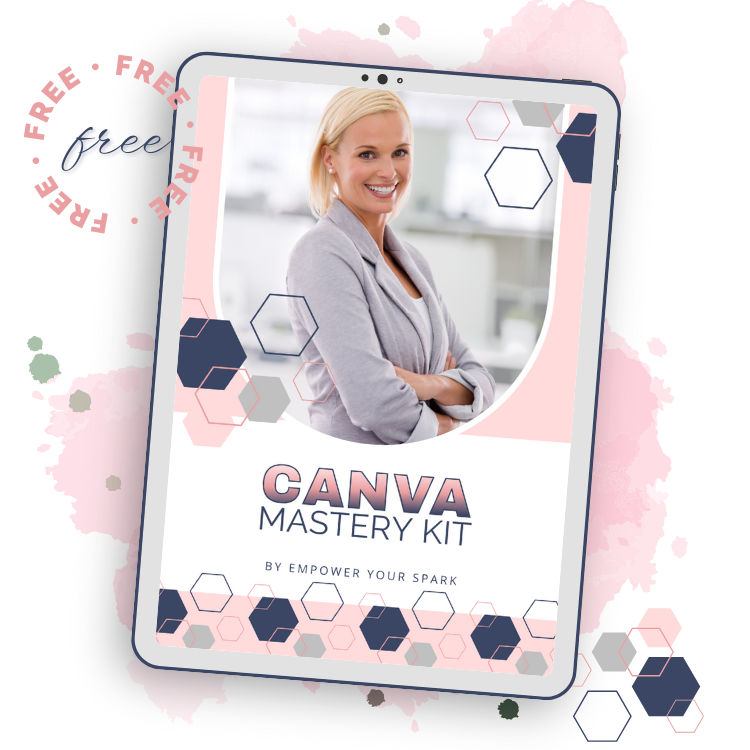
Get your FREE Canva Mastery Kit
A quick reference guide for Canva
FREE DOWNLOAD
Canva Mastery Kit
A Canva resource guide
Effortless Design Mastery: Discover time-saving shortcuts and techniques for polished Canva design
Professional Design Insights: Unlock tips for better Canva creations
Build Design Confidence: Gain skills for effortless creation
Stay up-to-date on socials:




Empower Your Spark © 2026. All Rights Reserved.