
Simplified Strategies & Support For
female entrepreneurs
~ Create, Grow & Thrive with Confidence ~
Hey there! You might find some affiliate links in this blog. If you decide to make a purchase through one, I may earn a small commission. It helps keep this space running, and I only share things I personally find valuable. Thanks for being here!
Blog Posts
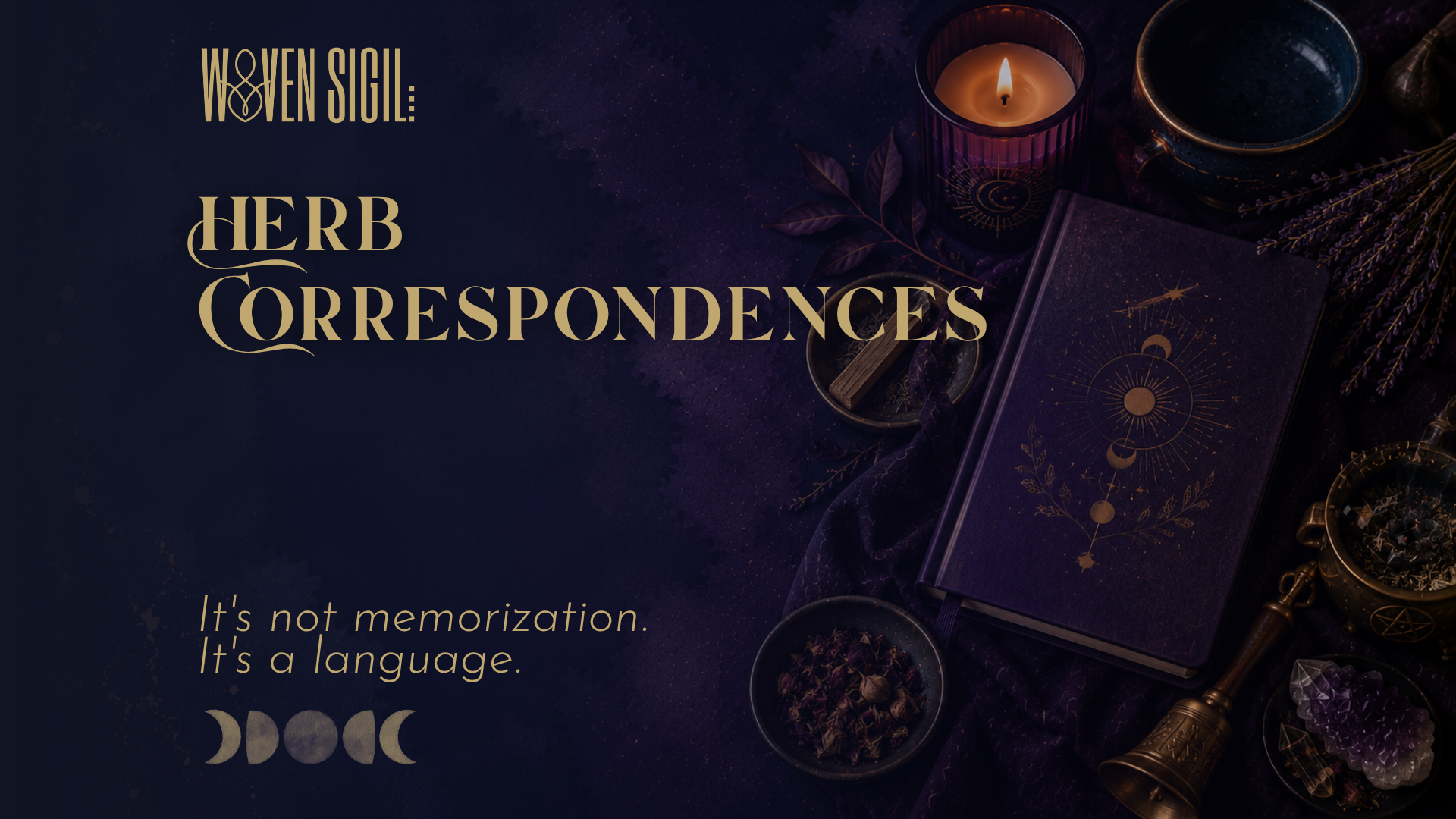
What Herb Correspondence Lists Don’t Tell You
Why herbs have the associations they do — and how to put them to work
Most people who get into herb work encounter correspondences the same way: a chart somewhere, or a book appendix, or a Pinterest infographic. Lavender = calm. Rosemary = protection. Cinnamon = abundance. They write it down, maybe buy a few herbs, and then stand in front of their altar not quite sure what to do next.
The problem isn't the list. The problem is that lists don't explain the logic, and without the logic, correspondences feel like rules someone made up that you're supposed to memorize and follow correctly.
They're not rules. They're a symbolic language. And like any language, they make more sense once you understand how they were built.
Where Correspondences Come From
Herb correspondences weren't invented by one person or tradition. They developed over centuries through folk practice, medicinal use, religious and magical traditions, astrology, observation, and the symbolism attached to plants over time. That's also why correspondence lists don't always agree. Different traditions emphasized different qualities, histories, and ways of understanding the same plant.
Take rosemary. It grows in dry, rocky, exposed conditions — it's tough. It has a sharp, clarifying scent that most people find mentally activating. Across European history and folklore, rosemary became strongly associated with remembrance, funerary customs, protection, and purification. It was hung in homes to deter pests and illness. It appears in folk practice across Europe as a protective herb, often placed at doorways, burned to clear a space, or worn to ward off harm. Those associations accumulated because people kept observing the same qualities and using the herb the same way across centuries and cultures.
That's part of the foundation of herb correspondences. They're not simply arbitrary labels. They reflect observation, historical use, symbolism, folklore, and the systems different traditions built around plants over time.
The Four Layers of a Correspondence
Understanding these layers makes correspondences usable rather than just memorable.
Sensory qualities. The most immediate layer. How does the herb smell? What does touching it feel like? Scent is particularly direct because it connects immediately to memory and mood — this is physiology, not metaphor. Lavender is calm and slightly medicinal. Clove is sharp and penetrating. Mugwort is bitter and a little…strange. These sensory qualities are real information about how you experience the plant and how its scent affects your state of mind. Pay attention to them before you consult any list.
Physical and historical use. What was this plant actually used for? Bay leaves (laurel) were used in victory wreaths and to anoint prophets and healers. Mugwort was carried by travelers and was believed to ease foot fatigue and offer protection on long roads. Sage was used for purification and preservation — its Latin name, Salvia, comes from a root associated with health, healing, and being whole. These historical uses are the practical record of how people experienced the plant's effects across generations. They're not decoration. They're why the correspondence says what it says.
Elemental and planetary associations. Many Western herb traditions assign correspondences to classical elements (earth, air, fire, water) and planets. The exact assignments vary by tradition and source, but they aren't meant to be literal — they're a framework for reasoning about a plant's qualities. Herbs associated with Fire often share qualities we read as fiery — warming, stimulating, sharp, or activating. Herbs associated with Earth may instead be linked through qualities like stability, protection, fertility, growth, or their connection to roots and the physical world. Once you understand the framework, you can make reasonable inferences about an unfamiliar herb: something warm, spicy, and dry-growing probably has fire qualities regardless of what the chart says.
Cultural and folk accumulation. Some correspondences are simply old — so well-established across so many traditions that they've become conventional. Salt for purification. Black pepper for banishing. Red for passion, white for clarity, black for protection and absorption. These accumulated associations are worth knowing and working with, even when the exact origin is impossible to trace. They carry weight because so many people have used them the same way for so long.
What "Working With" an Herb Actually Means
This is the part most content skips. You know the correspondence. Now what?
Scent as anchor. The simplest and often most consistent way to work with an herb is through its smell. When you're doing candle work, journaling, meditating, or setting intentions, having the herb present — dried in a small dish, as an oil, burned lightly — anchors your focus. The scent becomes associated with that mental state over time, which is why a ritual scent practice builds in usefulness the more consistently you use it. This isn't mystical — scent memory works this way for everyone, all the time.
Carrying and wearing. Small amounts of dried herb in a sachet, a pocket, or a small pouch are one of the oldest forms of folk practice. The herb stays in your physical space, its scent occasionally reaching you. This is most useful for herbs with protective or grounding correspondences — things you want as a steady background rather than a one-time working.
Cooking and tending. Kitchen witchcraft is largely about cooking with herbs intentionally. Bay leaves simmered into a pot. Rosemary rubbed onto food before roasting. Cinnamon stirred into morning coffee. The act of preparing food is already a daily ritual; adding intentional attention to which herbs you reach for and why is an extension of that, not a departure from ordinary life.
Burning. Dried herbs burned on a charcoal disc, as incense, or as part of a bundle are used for clearing, marking transitions, and altering the atmosphere of a space. Burning is more ephemeral than other methods — it's well-suited for one-time clearings or rituals rather than ongoing work.
Adding to spell jars and altar work. Herbs combined with other materials in a spell jar or placed on an altar do steady, slow work. Precision matters more here — combining herbs that work toward the same purpose is more effective than combining herbs aimed at different things. Five herbs all pointing toward protection is a clearer working than ten herbs pointing in five directions.
How to Choose When You're Unsure
You don't need to memorize every correspondence. You need to know how to reason through an unfamiliar herb or situation.
Start with scent. Smell it. What does your body do? Do your shoulders drop? Does your focus sharpen? Does it feel heavy or light? Your nervous system's response is real data, and it often aligns with what the traditional correspondence will say anyway.
Then consider what you're working toward. Correspondence matching is less about finding the "correct" herb and more about finding an herb whose qualities point in the same direction as your purpose. If you want to clear stagnant energy from a room, you want something sharp, clarifying, and purifying — rosemary, sage, juniper. If you want to draw warmth and movement, something activating — cinnamon, ginger, orange peel.
Your direct experience of how a plant affects you is useful information. If lavender settles your nervous system and you're doing calming or sleep work, that observation matters as much as the chart that agrees with you — and it would matter even if the chart didn't.
A Few Herbs Worth Knowing Well
Rather than a long list, a short one you can actually use:
Rosemary — Protection, clarity, memory. Sharp, resinous, penetrating. One of the most accessible protective herbs in folk tradition. Use it for clearing, warding, and anything requiring mental focus or alertness.
Lavender — Calm, peace, sleep, gentle purification. Light and slightly medicinal. Well-suited for stress work, sleep rituals, and anything where you need a quieter, more restful quality.
Cinnamon — Activation, warmth, prosperity, speed. Use it when you want to accelerate something or bring heat and movement to a working. It acts quickly and is one of the easier herbs to work with in everyday kitchen practice.
Bay leaf — Wishes, victory, blessing, clarity. Laurel has a long history of association with victory, honor, and divination. Writing an intention on a bay leaf and burning it is a simple practice commonly used in modern witchcraft.
Mugwort — Intuition, dreams, the liminal. Bitter and complex-smelling. Best for dream work, divination support, and ancestor connection. Use sparingly. Note: avoid if pregnant or trying to conceive.
Clove — Protection, banishing, strength. Very strong and specific. Use in small amounts in blends, where it can easily overpower everything else.
Sage — Purification, wisdom, clearing. Culinary sage (Salvia officinalis) is widely available, effective, and a sustainable option. If you're thinking about white sage specifically, this piece on ethical sourcing is worth reading first.
As always, use your own discernment and consult a qualified practitioner for anything related to your physical health.
Building Your Own Reference Over Time
The other thing lists can't give you is your own accumulated knowledge. Your experience of which herbs your nervous system responds to, which scents you associate with specific ritual states, which preparations you actually reach for — that knowledge is more useful to your practice than any chart.
Keep a simple record. Not a formal grimoire if that feels like too much, but some kind of note. What did you use, what were you working toward, what did you notice? Over a year of that, you'll have something more useful to your own practice than any published correspondence table could give you.
The correspondence list is a starting point and a shared language. The goal is to internalize the underlying logic so you can reason through new herbs, combine materials thoughtfully, and improvise when you need to.
If you want to see correspondences put to practical use, the Build an Autumn Kitchen Apothecary covers four specific autumn preparations. And if scent-based work interests you, this post on ritual herb oils and blending goes deeper into building a personal scent practice.

What Herb Correspondence Lists Don’t Tell You
Why herbs have the associations they do — and how to put them to work
Most people who get into herb work encounter correspondences the same way: a chart somewhere, or a book appendix, or a Pinterest infographic. Lavender = calm. Rosemary = protection. Cinnamon = abundance. They write it down, maybe buy a few herbs, and then stand in front of their altar not quite sure what to do next.
The problem isn't the list. The problem is that lists don't explain the logic, and without the logic, correspondences feel like rules someone made up that you're supposed to memorize and follow correctly.
They're not rules. They're a symbolic language. And like any language, they make more sense once you understand how they were built.
Where Correspondences Come From
Herb correspondences weren't invented by one person or tradition. They developed over centuries through folk practice, medicinal use, religious and magical traditions, astrology, observation, and the symbolism attached to plants over time. That's also why correspondence lists don't always agree. Different traditions emphasized different qualities, histories, and ways of understanding the same plant.
Take rosemary. It grows in dry, rocky, exposed conditions — it's tough. It has a sharp, clarifying scent that most people find mentally activating. Across European history and folklore, rosemary became strongly associated with remembrance, funerary customs, protection, and purification. It was hung in homes to deter pests and illness. It appears in folk practice across Europe as a protective herb, often placed at doorways, burned to clear a space, or worn to ward off harm. Those associations accumulated because people kept observing the same qualities and using the herb the same way across centuries and cultures.
That's part of the foundation of herb correspondences. They're not simply arbitrary labels. They reflect observation, historical use, symbolism, folklore, and the systems different traditions built around plants over time.
The Four Layers of a Correspondence
Understanding these layers makes correspondences usable rather than just memorable.
Sensory qualities. The most immediate layer. How does the herb smell? What does touching it feel like? Scent is particularly direct because it connects immediately to memory and mood — this is physiology, not metaphor. Lavender is calm and slightly medicinal. Clove is sharp and penetrating. Mugwort is bitter and a little…strange. These sensory qualities are real information about how you experience the plant and how its scent affects your state of mind. Pay attention to them before you consult any list.
Physical and historical use. What was this plant actually used for? Bay leaves (laurel) were used in victory wreaths and to anoint prophets and healers. Mugwort was carried by travelers and was believed to ease foot fatigue and offer protection on long roads. Sage was used for purification and preservation — its Latin name, Salvia, comes from a root associated with health, healing, and being whole. These historical uses are the practical record of how people experienced the plant's effects across generations. They're not decoration. They're why the correspondence says what it says.
Elemental and planetary associations. Many Western herb traditions assign correspondences to classical elements (earth, air, fire, water) and planets. The exact assignments vary by tradition and source, but they aren't meant to be literal — they're a framework for reasoning about a plant's qualities. Herbs associated with Fire often share qualities we read as fiery — warming, stimulating, sharp, or activating. Herbs associated with Earth may instead be linked through qualities like stability, protection, fertility, growth, or their connection to roots and the physical world. Once you understand the framework, you can make reasonable inferences about an unfamiliar herb: something warm, spicy, and dry-growing probably has fire qualities regardless of what the chart says.
Cultural and folk accumulation. Some correspondences are simply old — so well-established across so many traditions that they've become conventional. Salt for purification. Black pepper for banishing. Red for passion, white for clarity, black for protection and absorption. These accumulated associations are worth knowing and working with, even when the exact origin is impossible to trace. They carry weight because so many people have used them the same way for so long.
What "Working With" an Herb Actually Means
This is the part most content skips. You know the correspondence. Now what?
Scent as anchor. The simplest and often most consistent way to work with an herb is through its smell. When you're doing candle work, journaling, meditating, or setting intentions, having the herb present — dried in a small dish, as an oil, burned lightly — anchors your focus. The scent becomes associated with that mental state over time, which is why a ritual scent practice builds in usefulness the more consistently you use it. This isn't mystical — scent memory works this way for everyone, all the time.
Carrying and wearing. Small amounts of dried herb in a sachet, a pocket, or a small pouch are one of the oldest forms of folk practice. The herb stays in your physical space, its scent occasionally reaching you. This is most useful for herbs with protective or grounding correspondences — things you want as a steady background rather than a one-time working.
Cooking and tending. Kitchen witchcraft is largely about cooking with herbs intentionally. Bay leaves simmered into a pot. Rosemary rubbed onto food before roasting. Cinnamon stirred into morning coffee. The act of preparing food is already a daily ritual; adding intentional attention to which herbs you reach for and why is an extension of that, not a departure from ordinary life.
Burning. Dried herbs burned on a charcoal disc, as incense, or as part of a bundle are used for clearing, marking transitions, and altering the atmosphere of a space. Burning is more ephemeral than other methods — it's well-suited for one-time clearings or rituals rather than ongoing work.
Adding to spell jars and altar work. Herbs combined with other materials in a spell jar or placed on an altar do steady, slow work. Precision matters more here — combining herbs that work toward the same purpose is more effective than combining herbs aimed at different things. Five herbs all pointing toward protection is a clearer working than ten herbs pointing in five directions.
How to Choose When You're Unsure
You don't need to memorize every correspondence. You need to know how to reason through an unfamiliar herb or situation.
Start with scent. Smell it. What does your body do? Do your shoulders drop? Does your focus sharpen? Does it feel heavy or light? Your nervous system's response is real data, and it often aligns with what the traditional correspondence will say anyway.
Then consider what you're working toward. Correspondence matching is less about finding the "correct" herb and more about finding an herb whose qualities point in the same direction as your purpose. If you want to clear stagnant energy from a room, you want something sharp, clarifying, and purifying — rosemary, sage, juniper. If you want to draw warmth and movement, something activating — cinnamon, ginger, orange peel.
Your direct experience of how a plant affects you is useful information. If lavender settles your nervous system and you're doing calming or sleep work, that observation matters as much as the chart that agrees with you — and it would matter even if the chart didn't.
A Few Herbs Worth Knowing Well
Rather than a long list, a short one you can actually use:
Rosemary — Protection, clarity, memory. Sharp, resinous, penetrating. One of the most accessible protective herbs in folk tradition. Use it for clearing, warding, and anything requiring mental focus or alertness.
Lavender — Calm, peace, sleep, gentle purification. Light and slightly medicinal. Well-suited for stress work, sleep rituals, and anything where you need a quieter, more restful quality.
Cinnamon — Activation, warmth, prosperity, speed. Use it when you want to accelerate something or bring heat and movement to a working. It acts quickly and is one of the easier herbs to work with in everyday kitchen practice.
Bay leaf — Wishes, victory, blessing, clarity. Laurel has a long history of association with victory, honor, and divination. Writing an intention on a bay leaf and burning it is a simple practice commonly used in modern witchcraft.
Mugwort — Intuition, dreams, the liminal. Bitter and complex-smelling. Best for dream work, divination support, and ancestor connection. Use sparingly. Note: avoid if pregnant or trying to conceive.
Clove — Protection, banishing, strength. Very strong and specific. Use in small amounts in blends, where it can easily overpower everything else.
Sage — Purification, wisdom, clearing. Culinary sage (Salvia officinalis) is widely available, effective, and a sustainable option. If you're thinking about white sage specifically, this piece on ethical sourcing is worth reading first.
As always, use your own discernment and consult a qualified practitioner for anything related to your physical health.
Building Your Own Reference Over Time
The other thing lists can't give you is your own accumulated knowledge. Your experience of which herbs your nervous system responds to, which scents you associate with specific ritual states, which preparations you actually reach for — that knowledge is more useful to your practice than any chart.
Keep a simple record. Not a formal grimoire if that feels like too much, but some kind of note. What did you use, what were you working toward, what did you notice? Over a year of that, you'll have something more useful to your own practice than any published correspondence table could give you.
The correspondence list is a starting point and a shared language. The goal is to internalize the underlying logic so you can reason through new herbs, combine materials thoughtfully, and improvise when you need to.
If you want to see correspondences put to practical use, the Build an Autumn Kitchen Apothecary covers four specific autumn preparations. And if scent-based work interests you, this post on ritual herb oils and blending goes deeper into building a personal scent practice.
Follow Us!


Get your FREE Canva Mastery Kit
A quick reference guide for Canva
FREE DOWNLOAD
Canva Mastery Kit
A Canva resource guide
Effortless Design Mastery: Discover time-saving shortcuts and techniques for polished Canva design
Professional Design Insights: Unlock tips for better Canva creations
Build Design Confidence: Gain skills for effortless creation
Stay up-to-date on socials:




Empower Your Spark © 2026. All Rights Reserved.